
Amidst today’s fast-paced and highly competitive business environment, it is crucial for investors and industry enthusiasts to conduct comprehensive company evaluations. In this article, we will delve into an extensive industry comparison, evaluating Meta Platforms (NASDAQ:META) in comparison to its major competitors within the Interactive Media & Services industry. By analyzing critical financial metrics, market position, and growth potential, our objective is to provide valuable insights for investors and offer a deeper understanding of company’s performance in the industry.
Meta Platforms Background
Meta is the largest social media company in the world, boasting close to 4 billion monthly active users worldwide. The firm’s “Family of Apps,” its core business, consists of Facebook, Instagram, Messenger, and WhatsApp. End users can leverage these applications for a variety of different purposes, from keeping in touch with friends to following celebrities and running digital businesses for free. Meta packages customer data, gleaned from its application ecosystem and sells ads to digital advertisers. While the firm has been investing heavily in its Reality Labs business, it remains a very small part of Meta’s overall sales.
| Company | P/E | P/B | P/S | ROE | EBITDA (in billions) | Gross Profit (in billions) | Revenue Growth |
|---|---|---|---|---|---|---|---|
| Meta Platforms Inc | 28.15 | 8.26 | 8.68 | 1.39% | $26.85 | $42.04 | 26.25% |
| Alphabet Inc | 31.93 | 10.09 | 10.29 | 9.33% | $49.74 | $60.98 | 15.95% |
| Reddit Inc | 100.68 | 15.86 | 22.45 | 6.51% | $0.14 | $0.53 | 67.91% |
| Baidu Inc | 10.75 | 1.09 | 2.18 | 2.69% | $8.84 | $14.36 | -3.59% |
| Pinterest Inc | 8.95 | 3.57 | 4.34 | 1.91% | $0.07 | $0.84 | 16.79% |
| Bilibili Inc | 107.27 | 5.36 | 2.81 | 3.24% | $0.5 | $2.82 | 5.2% |
| CarGurus Inc | 24.34 | 9.16 | 4.04 | 11.03% | $0.06 | $0.21 | 3.17% |
| ZoomInfo Technologies Inc | 31.03 | 1.96 | 2.58 | 2.51% | $0.09 | $0.27 | 4.74% |
| Weibo Corp | 5.71 | 0.64 | 1.54 | 3.58% | $0.15 | $0.34 | 1.58% |
| Yelp Inc | 13.12 | 2.46 | 1.34 | 5.32% | $0.07 | $0.34 | 4.36% |
| Tripadvisor Inc | 25.32 | 2.51 | 1.10 | 7.95% | $0.1 | $0.51 | 3.95% |
| Ziff Davis Inc | 12.70 | 0.72 | 0.94 | -0.2% | $0.07 | $0.31 | 2.87% |
| Taboola.com Ltd | 50.75 | 1.28 | 0.70 | 0.57% | $0.03 | $0.14 | 14.72% |
| Hello Group Inc | 10.55 | 0.74 | 0.84 | -1.28% | $0.53 | $1.01 | -2.64% |
| Yalla Group Ltd | 8.72 | 1.43 | 3.71 | 5.38% | $0.03 | $0.06 | 0.8% |
| Average | 31.56 | 4.06 | 4.2 | 4.18% | $4.32 | $5.91 | 9.7% |
table {
width: 100%;
border-collapse: collapse;
font-family: Arial, sans-serif;
font-size: 14px;
}
th, td {
padding: 8px;
text-align: left;
}
th {
background-color: #293a5a;
color: #fff;
text-align: left;
}
tr:nth-child(even) {
background-color: #f2f4f8;
}
tr:hover {
background-color: #e1e4ea;
}
td:nth-child(3), td:nth-child(5) {
text-align: left;
}
.dividend-amount {
font-weight: bold;
color: #0d6efd;
}
.dividend-frequency {
font-size: 12px;
color: #6c757d;
}
By thoroughly analyzing Meta Platforms, we can discern the following trends:
-
A Price to Earnings ratio of 28.15 significantly below the industry average by 0.89x suggests undervaluation. This can make the stock appealing for those seeking growth.
-
With a Price to Book ratio of 8.26, which is 2.03x the industry average, Meta Platforms might be considered overvalued in terms of its book value, as it is trading at a higher multiple compared to its industry peers.
-
The stock’s relatively high Price to Sales ratio of 8.68, surpassing the industry average by 2.07x, may indicate an aspect of overvaluation in terms of sales performance.
-
The company has a lower Return on Equity (ROE) of 1.39%, which is 2.79% below the industry average. This indicates potential inefficiency in utilizing equity to generate profits, which could be attributed to various factors.
-
The company exhibits higher Earnings Before Interest, Taxes, Depreciation, and Amortization (EBITDA) of $26.85 Billion, which is 6.22x above the industry average, implying stronger profitability and robust cash flow generation.
-
With higher gross profit of $42.04 Billion, which indicates 7.11x above the industry average, the company demonstrates stronger profitability and higher earnings from its core operations.
-
The company is experiencing remarkable revenue growth, with a rate of 26.25%, outperforming the industry average of 9.7%.
Debt To Equity Ratio
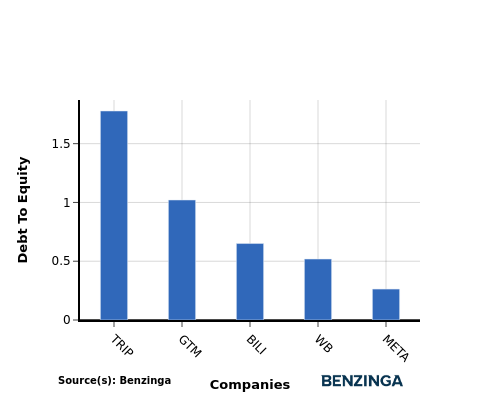
The debt-to-equity (D/E) ratio helps evaluate the capital structure and financial leverage of a company.
Considering the debt-to-equity ratio in industry comparisons allows for a concise evaluation of a company’s financial health and risk profile, aiding in informed decision-making.
When examining Meta Platforms in comparison to its top 4 peers with respect to the Debt-to-Equity ratio, the following information becomes apparent:
-
Compared to its top 4 peers, Meta Platforms has a stronger financial position indicated by its lower debt-to-equity ratio of 0.26.
-
This suggests that the company relies less on debt financing and has a more favorable balance between debt and equity, which can be seen as a positive attribute by investors.
Key Takeaways
For Meta Platforms, the PE ratio is low compared to peers, indicating potential undervaluation. The PB and PS ratios are high, suggesting overvaluation relative to industry standards. In terms of ROE, Meta Platforms shows lower profitability, while EBITDA, gross profit, and revenue growth are all high, indicating strong operational performance within the Interactive Media & Services sector.
This article was generated by Benzinga’s automated content engine and reviewed by an editor.